Why Your Brain Still Falls for the Oldest Price Trick in the Book
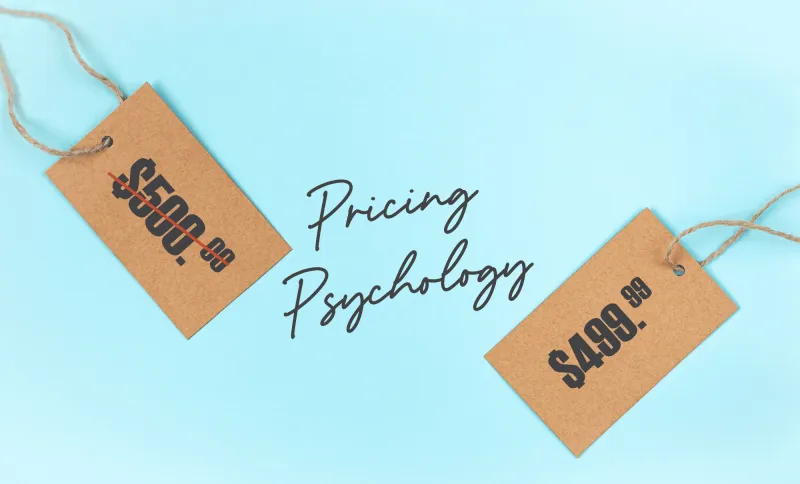
Photo: price tag retail store shopping psychology, via www.upflip.com
You've been shopping long enough to know the deal. That jacket isn't $79. It's $79.99. You're not saving anything meaningful. The store isn't doing you a favor. And yet — somewhere between glancing at the tag and reaching for your wallet — something in your brain quietly decides that $79.99 feels substantially cheaper than $80. It happens fast. It happens without permission. And it happens to pretty much everyone, including people who write articles about it.
This is charm pricing, and it's one of the most studied, most replicated, and most stubbornly effective psychological quirks in all of consumer behavior. In 2024, with AI-personalized shopping experiences and infinite consumer awareness at our fingertips, the humble digit 9 is still out here doing heavy lifting for retailers everywhere.
A Trick That Predates the Internet by About 100 Years
Charm pricing didn't start with Amazon's algorithm. It goes back to at least the late 1800s, when American retailers discovered that odd-cent pricing helped reduce employee theft — cashiers had to open the register to make change, which created a paper trail. The psychological benefit was sort of a happy accident that merchants quickly noticed and never stopped exploiting.
By the mid-20th century, ending prices in 9 was basically standard practice in American retail. Department stores, gas stations, grocery chains — everyone was in on it. The reasoning was simple: consumers read numbers left to right, and the leftmost digit anchors perception. $49.99 registers mentally closer to $49 than $50, even though the actual difference is one cent. Researchers call this "left-digit anchoring," and it's been documented in study after study across decades.
A landmark study published in the journal Quantitative Marketing and Economics found that demand for an item actually increased when the price was raised from $34 to $39. Not decreased — increased. That's how powerful the 9 effect is. The price went up, and people bought more of it.
What's Actually Happening Inside Your Head
Here's where it gets interesting. Neuroscientists studying price perception have found that our brains process numbers the way they process most information: quickly, imperfectly, and with a whole lot of shortcuts. When you see $79.99, your visual cortex processes the 7 before it fully registers the 9s trailing behind it. By the time your conscious brain is doing the math, your emotional brain has already filed this under "closer to seventy dollars than eighty."
This isn't a flaw, exactly. It's a feature of how human cognition handles the sheer volume of information we process daily. Mental shortcuts — what psychologists call heuristics — are how we function without burning out. The problem is that retailers have spent generations learning exactly which shortcuts to exploit.
Functional MRI studies have shown that prices ending in round numbers activate slightly more cognitive effort than charm prices. In other words, $80 makes you think a little harder than $79.99. And thinking harder, in a shopping context, often means second-guessing yourself — which can mean putting the item back. Retailers don't want you thinking harder. They want you moving toward the checkout.
E-Commerce Made It Weirder
Online shopping didn't kill charm pricing. If anything, it gave it new life. When you're scrolling through hundreds of products on a website, your brain is doing even more filtering than it does in a physical store. You're skimming. You're comparing. You're making split-second decisions about what even deserves a closer look. In that environment, a price ending in 9 still registers as a psychological bargain signal before you've even consciously processed the product.
What's changed is the sophistication of the delivery. Modern e-commerce platforms use dynamic pricing — prices that shift based on your browsing history, location, the time of day, even the device you're using. And those dynamically generated prices? They almost always end in 9. The algorithm might be personalizing everything else about your experience, but it's not messing with the digit that's worked since the McKinley administration.
AI-driven personalization adds another layer. If a platform knows you've been browsing running shoes for two weeks, it can surface a pair at $89.99 at exactly the moment your interest peaks — timed to feel like a deal you'd be foolish to pass up. The charm pricing is the same old trick. The targeting wrapped around it is brand new.
So Can You Actually Outsmart It?
Here's the honest answer: sort of. Awareness helps a little, but not as much as we'd like to think. Researchers have found that even consumers who are explicitly told about left-digit anchoring before making a purchase still show the same pricing biases. Knowing the trick is not the same as being immune to it.
What does help is deliberate friction. Before completing a purchase, round the price up in your head. If something costs $129.99, consciously think: this is $130. Force your brain to do the work it was trying to skip. It sounds almost embarrassingly simple, but creating that tiny mental pause — even 79 seconds of it — changes the cognitive context enough to engage more rational evaluation.
Shopping with a budget written down (not just in your head) also helps. A concrete number gives your brain an anchor that competes with the retailer's anchor. Instead of comparing $79.99 to an abstract sense of "expensive" or "not expensive," you're comparing it to a specific dollar amount you decided on before the store got involved.
Price comparison tools and browser extensions that track historical pricing can also strip away the illusion of urgency that charm pricing often travels with. When you can see that an item has been $79.99 for six straight months, the psychological pressure of right now deflates pretty quickly.
The Takeaway
Charm pricing has survived a century of retail evolution, the rise of the internet, and now the age of AI personalization — not because consumers are foolish, but because it works with the brain's actual architecture. The digit 9 isn't magic. It's just really good at exploiting the way human cognition handles numbers under low-attention conditions.
The next time you feel weirdly good about a price that ends in .99, that feeling is real. It's just not based on anything the math would support. And now that you know that, you're maybe 10% better equipped to notice it happening. The other 90% is still going to need some practice.