Who Are You Online, Anyway? Inside America's Many-Faced Digital Identity Crisis
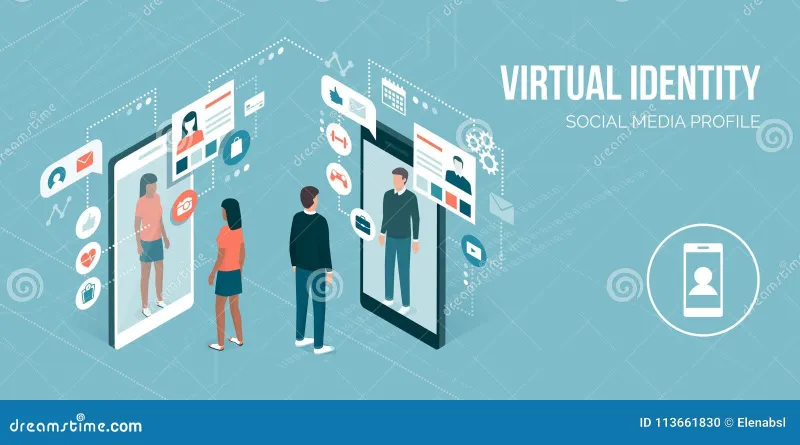
Photo: person multiple social media profiles smartphone identity digital, via thumbs.dreamstime.com
Let's play a game. Open LinkedIn, then TikTok, then your most-used Reddit account. Look at the three profiles side by side. Same person?
Technically, sure. But scroll through the content, the tone, the things you've said and shared and confessed in each space — and you might feel like you're looking at three strangers who happen to share a Social Security number.
This is the reality for tens of millions of Americans right now. We are, quietly and somewhat unconsciously, living multiple lives online. And nobody's really talking about what that's doing to us.
The Platform-by-Platform Breakdown of the American Self
Think about how differently you present yourself depending on where you're posting. LinkedIn is the highlight reel — professional wins, thought leadership, careful language, a headshot where you look like you have your life together. TikTok is looser, weirder, maybe funnier. Instagram sits somewhere in between: curated but personal, aspirational but relatable.
And then there's Reddit. Or X (formerly Twitter). Or Discord servers. Or anonymous forums where you've said things you'd never attach your real name to in a million years.
Social psychologist Erving Goffman called this kind of thing "impression management" back in 1959 — the idea that we all perform different versions of ourselves depending on our audience, the same way an actor shifts between roles. What Goffman couldn't have anticipated was a world where you're performing simultaneously, for wildly different audiences, with permanent receipts.
Why We Fragment — And Why It Feels Natural
Here's the thing: maintaining different personas isn't inherently weird or dishonest. Humans have always code-switched. You talk differently to your boss than you do to your best friend. You probably don't tell your grandmother the same stories you tell your college roommates. Context shapes expression — that's just being a social creature.
What's different now is the scale and the permanence. And the fact that platforms are specifically engineered to encourage a particular version of you.
TikTok's algorithm rewards authenticity, vulnerability, and entertainment. LinkedIn rewards professionalism and achievement signaling. Reddit rewards anonymity, niche knowledge, and a certain kind of brutal honesty that would be socially catastrophic anywhere else. Each platform creates its own gravitational pull, bending your self-presentation toward what gets rewarded in that ecosystem.
Over time, you don't just perform differently in each space. You start to think differently in each space. The TikTok version of you becomes a real version of you. So does the Reddit one.
The Mental Health Angle Nobody Wants to Talk About
Psychologists are increasingly paying attention to what happens when the distance between our various online selves gets too wide. Research published in journals studying digital behavior has found correlations between high levels of online identity fragmentation and elevated rates of anxiety, loneliness, and what researchers call "self-concept confusion" — essentially, losing your grip on who you actually are at the core.
That might sound dramatic, but consider: if you've spent years being brutally sarcastic and anonymous on Reddit, warmly inspirational on Instagram, and ruthlessly competent on LinkedIn — which one is you? And what happens when those worlds collide?
They do collide. They always do eventually. The anonymous account gets traced back. The TikTok goes viral and your coworkers find it. The LinkedIn connection requests the person you've only ever known as a Reddit username. These moments of "context collapse" — when audiences that were supposed to stay separate suddenly merge — can be genuinely destabilizing.
But Is It All Bad? A More Complicated Take
Here's where it gets interesting. For a lot of people — particularly those who belong to marginalized communities, or who are navigating complex personal identities — online persona fragmentation isn't erosion. It's survival.
A gay teenager in a conservative small town might be fully out in a private Discord server and completely closeted on the family-connected Facebook account. A woman of color in a predominantly white corporate environment might use LinkedIn to navigate professional norms while using a separate Twitter account to speak freely about experiences she can't safely voice at work. For these users, maintaining separate identities isn't confusion — it's self-protection, and sometimes self-discovery.
There's also a genuine argument that the internet has given people permission to explore facets of themselves that social geography would otherwise suppress. The shy accountant from Ohio who becomes a beloved Twitch streamer isn't being fake — they're accessing a real part of themselves that their offline context never had space for.
The Authenticity Paradox
So where does that leave us with the concept of authenticity — that thing we're all supposedly chasing?
Maybe authenticity was always more complicated than the "just be yourself" slogan suggests. "Yourself" is not a single, fixed thing. It's a collection of tendencies, contexts, moods, and relationships. The version of you that exists in your childhood home is no less real than the version of you that exists at a work conference. They're both you. They just have different things to say.
The problem isn't having multiple online selves. The problem is when those selves start actively contradicting each other in ways you can't reconcile — when the gap between who you perform and who you feel becomes a source of chronic dissonance rather than creative range.
The healthiest digital citizens seem to be the ones who maintain some awareness of the throughline. They know that their LinkedIn voice and their Reddit voice are both costumes on the same person, and they haven't lost the thread back to who that person actually is.
So What Do You Do With All This?
You probably can't — and shouldn't necessarily try to — collapse all your online personas into one. That's not realistic, and for many people, it's not even desirable.
But it might be worth occasionally auditing the different versions of yourself you're running online. Do they feel like variations on a theme, or do they feel like completely unrelated characters? Is there a version of you that only exists online and has no real-life counterpart? How would you feel if the people in one digital world suddenly had access to all the others?
Those questions don't have clean answers. But asking them is probably the most honest thing you can do in a world that's constantly offering you new masks to wear.
After all, the internet gives you an almost unlimited wardrobe. The trick is remembering there's still a person underneath all the outfits.