Half-Finished and Loving It: The Quiet Revolution of Doing Things Badly on Purpose
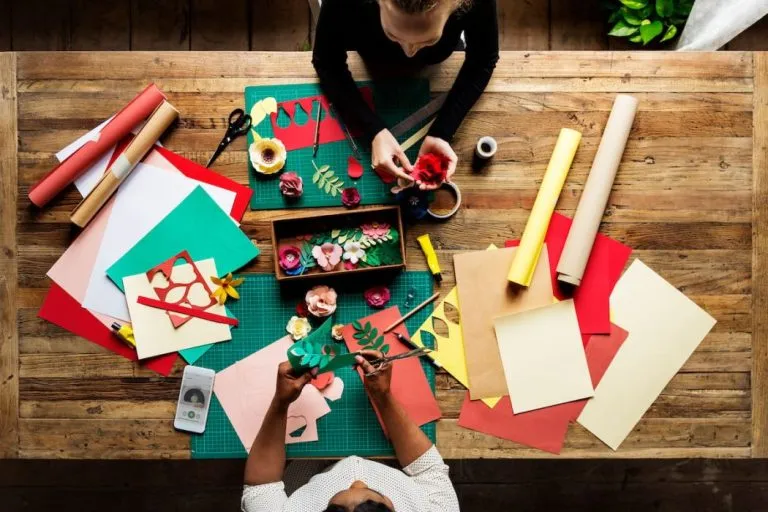
Photo: person doing arts and crafts hobby at home table surrounded by colorful supplies, via hobbyknowhow.com
There's a half-crocheted blanket in a tote bag in a closet in approximately 40% of American homes right now. Maybe it's yours. Maybe you started it during the pandemic with big ambitions and a YouTube tutorial, got about a third of the way through, and then life happened. It's been sitting there for two years. You feel a little guilty about it every time you open that closet.
But what if the blanket isn't a failure? What if it's actually the point?
Something interesting is happening in American creative culture, and it's showing up in the comment sections of TikTok craft videos, in the explosion of beginner Etsy shops, in the DIY subreddits and the watercolor-for-fun Facebook groups. People are making things they're not good at, finishing projects at a rate of about 50%, sharing work that is charmingly, visibly imperfect — and actively resisting the pressure to turn any of it into a side hustle, a brand, or a polished final product.
Call it the Good Enough Revolution. It's messier than minimalism and quieter than the anti-hustle movement, but it might be the most genuinely countercultural thing happening in American life right now.
The Hustle Hangover
To understand why this is resonating, you have to understand what it's pushing back against. For roughly a decade, American cultural messaging around creativity went through a very specific phase: everything you love doing should be monetized. Your hobby is actually a side hustle waiting to happen. Your passion project is a startup in disguise. The implicit message was that creative activity only counted if it produced something — income, followers, a product someone could buy.
This wasn't entirely cynical. It came packaged with real empowerment language: be your own boss, turn your passion into profit, build something that's yours. And for some people, it worked beautifully. But for a lot of others, it quietly poisoned the well. When your hobby becomes a job, it starts to feel like a job. The stakes go up. The fun drains out. You start optimizing instead of exploring.
Millennials and Gen Z watched this happen in real time — to themselves, to people they followed online, to the creators they loved who burned out spectacularly and publicly. And a significant number of them decided, more or less consciously, that they wanted something different.
The Imperfect Thing Is the Whole Thing
What's striking about the current moment is that "good enough" isn't being framed as settling. It's being reframed as the actual goal.
On TikTok, the cottage-core and goblincore aesthetics celebrate handmade things with visible seams. "Cozy gamer" culture explicitly rejects competitive achievement in favor of just wandering around in a pretty video game world doing nothing in particular. The "chaotic crafter" archetype — someone who starts 15 projects, finishes maybe 3, and documents all of it with cheerful self-deprecation — has become its own genre of content with millions of followers.
Etsy shops run by people who are clearly learning as they go, selling things that are imperfect and priced accordingly, have found devoted audiences. Not in spite of the imperfection, but partly because of it. There's something genuinely refreshing about a product that carries evidence of a human hand that didn't quite know what it was doing yet.
This isn't about lowering standards, exactly. It's about detaching standards from worth. The thing you make doesn't have to be excellent to justify the time you spent making it.
The Neuroscience of Messing Around
Here's where it gets interesting: there's actual science behind why unstructured, low-stakes creative activity feels good in a way that outcome-focused work often doesn't.
When you engage in creative play without a defined goal, your brain activates what researchers call the default mode network — the same neural circuitry that's active during daydreaming, self-reflection, and the generation of new ideas. It's a kind of productive wandering, and it's associated with insight, emotional processing, and genuine rest in a way that passive consumption (hi, scrolling) often isn't.
In other words, badly knitting a scarf you'll never finish is genuinely restorative in a way that watching knitting videos probably isn't. Your hands are busy. Your mind is loosely engaged but not strained. There's no performance pressure. You're just... in it.
Psychologists have a name for this state — flow — though it's usually associated with high-skill activities. But the early, clumsy stages of learning something new can produce a gentler version of the same effect. The beginner's mind, as it's sometimes called, is actually a pretty great place to spend time.
What This Says About Ambition (and Us)
There's a broader cultural reading here that's worth sitting with. The embrace of creative "good enough" is partly a response to a specific kind of American exhaustion — the exhaustion of treating every activity as an optimization problem, every skill as a career asset, every moment as something to be productive with.
Younger Americans especially have grown up in an environment of relentless measurement: grades, follower counts, performance reviews, credit scores, step counts. The quantification of life is so pervasive that it barely registers anymore. Against that backdrop, doing something that produces nothing measurable — a half-finished blanket, a terrible watercolor of your dog, a song recorded on your phone that only you will ever hear — is almost a radical act.
It's a way of saying: I exist outside of my metrics. I am not only what I produce.
That's not a rejection of ambition, exactly. Most of the people knitting wonky scarves and starting Etsy shops that make $200 a year are still ambitious in other parts of their lives. But they're carving out a protected space where ambition doesn't get to follow them. Where the only standard is whether they enjoyed the process.
The Unfinished Project Is Not the Problem
So about that blanket in the tote bag. Here's a reframe worth trying: what if its value was entirely in the hours you spent making it? The YouTube tutorials you watched. The slight meditative quality of the repetitive motion. The mild pride when a row came out right. The decision to put it down when life got busy, without guilt, because it was never a commitment — it was just something you were playing with.
The finished blanket would have been nice. But the unfinished one kept you company for a while, gave your hands something to do, and cost you nothing except some yarn and some time you probably would have spent scrolling anyway.
That's not failure. That's a pretty decent trade.
America is slowly, unevenly, imperfectly learning to let creative things be what they are — not products, not brands, not proof of anything. Just the thing you made, as well as you could, for as long as it was fun. The revolution won't be polished. It'll have visible seams and uneven edges and at least one corner that came out completely wrong.
Honestly? That sounds about right.